Overview
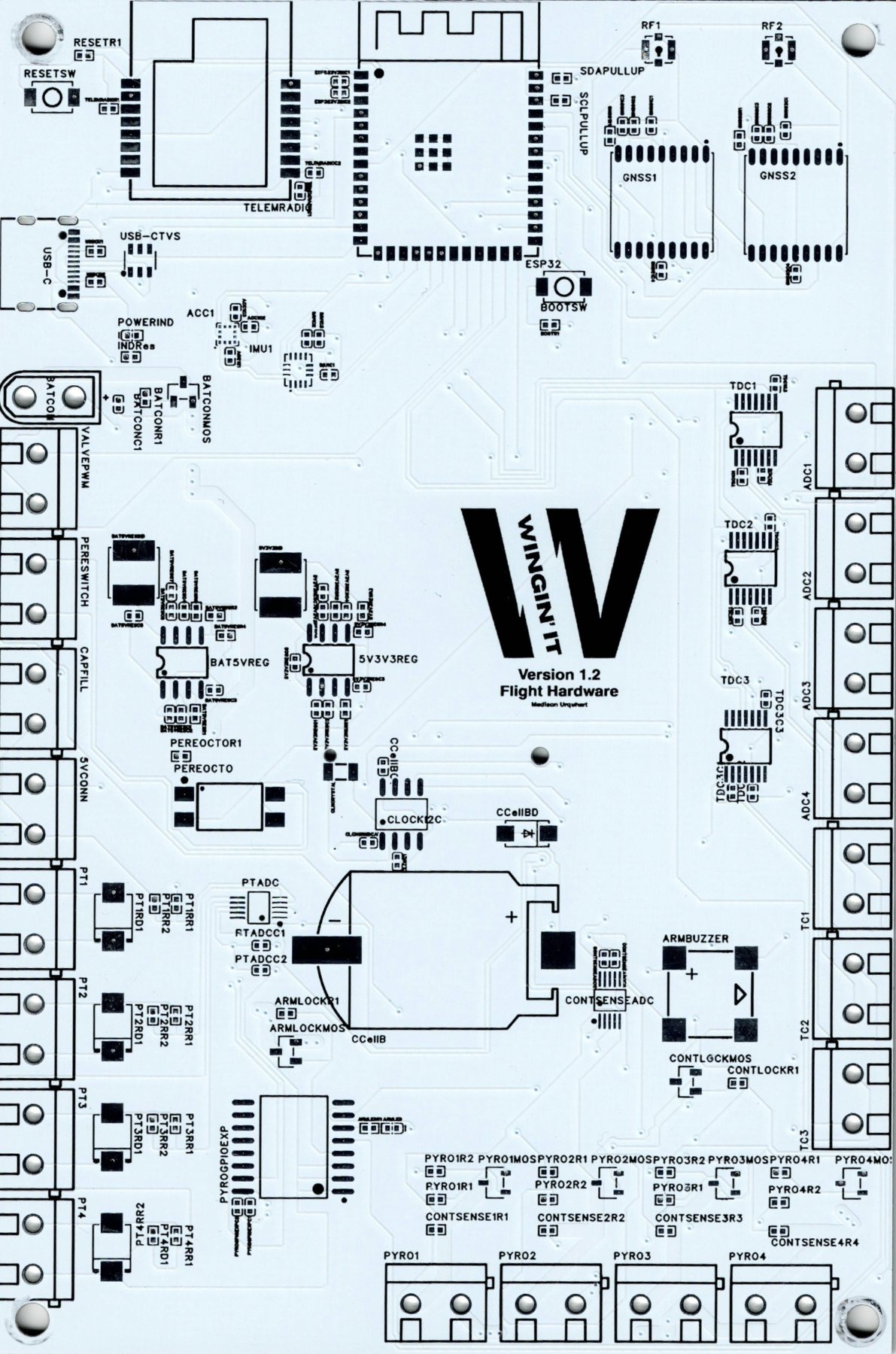
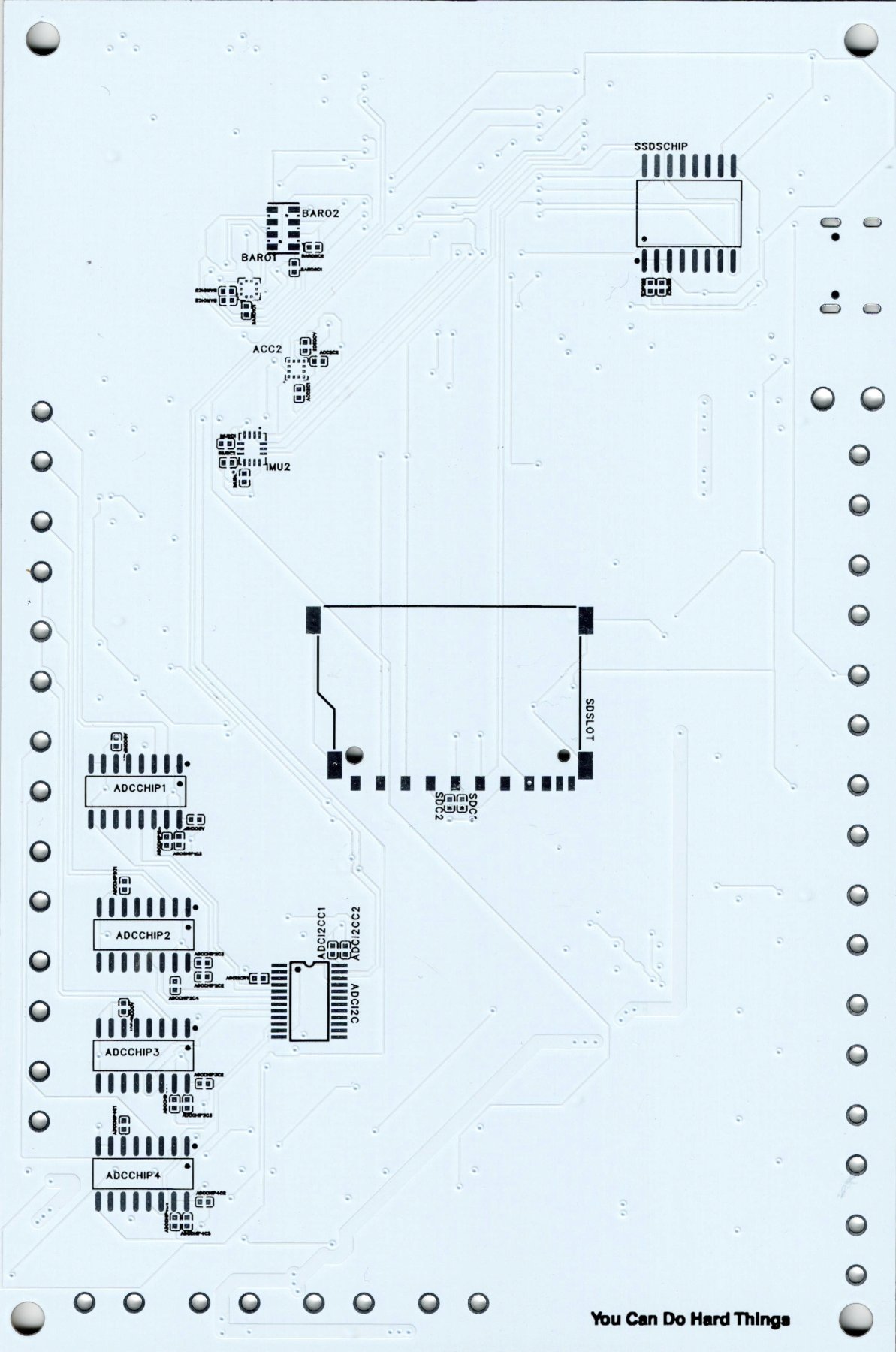
Wingin' It was my first-ever attempt at a PCB, and I certainly had lofty goals. My requirements included Telemetry over LoRa, Data Acquisition Capability (Load Cells, Thermocouples, and Pressure Transducers), and critical component redundancy across Accelerometers, IMUs, GPS, Barometers.
Design, Build, Test, and Analysis
As you may expect for someone's first PCB, it certainly was a wild ride. I opted to PCBA in-house to save a significant amount of cost and I unfortunately had not realized the difficulty of doing a board this size, with this many 0402 passives and fine pitch LGA components, on my own. I soldered board SN01 over the course of 2 weeks and attempted to power up the board over a 3S LiPo as intended. Unfortunately the board did not show any signs of life and I had to begin investigating. After a few hours probing with a multimeter, I found that neither my 5V Regulator nor my 3.3V Regulator were outputting anywhere near their target output. I checked this against my schematic and could not find an obvious error, so I moved forward under the assumption that I had mixed up a resistor placement during PCBA.
In the interest of testing the rest of the board, I decided to bypass the board's regulation using a screw regulator with an output set at 3.3V. This resulted in my 3.3V LED indicator light powering on. Following this indication I plugged in a USB-C connector into the onboard port to begin flashing my software. However, it was not that easy. The ESP32-S3 was unfortunately not showing over serial as it should have. I spent a few days attempting to debug this by replacing every possible component along the line of transmission along with confirming the chip was seeing proper voltages via Multimeter probing. After trying every other option I had available, I transplanted a development board ESP32-S3 module onto SN01 following successful chip checkouts while on the original development board. Unfortunately this did not solve it and I still had no serial connection, even after doing continuity checks on each pin to ensure no shorting occurred. I then desoldered the ESP32-S3 module from Wingin' It and placed it back on the original development board to see if the heat gun had damaged it mid-transplant. The ESP32-S3 was alive & well once it was back onto the development board, so I knew it was not the chip.
Unfortunately, during a 2nd verification round of this transplant testing a fire occurred at the XT-30 connector. Luckily I was able to extinguish this fire nearly instantly, but the power nets were left permanently shorted to the ground copper layer. After a very short investigation, I found a small piece of solder wire was left on my soldering mat and caused a bridge between the positive & negative legs of the XT-30. The damage to the board was unfortunately not fixable, and I knew this board revision was not flyable at this point due to the numerous design & timeline issues present, even on a spare copy. However I still wanted to gather as much data from this board's design as possible, so I decided to transplant select ICs from SN01 to SN02, and use another spare S3 development board and bodge connections as I needed them. Initially my goal was to test the Pressure Transducer DAQ setup.
Following successful bodging and software testing, I wired the board to a 1000PSI 5V Pressure Transducer with the intention to test it using hydrostatic pressure. During the test, both Pressure Transducers were reading far lower than our manual gauge and seemed to be hitting some sort of ceiling. I tested with an alternate Pressure Transducer made by a different manufacturer and I saw identical results. After doing a few hours of investigation, I found that an inadequately-rated clamping diode was causing it to clamp with lower voltage than I had intended. To solve this issue, I removed the diodes from each of the 4 PT inputs, and tested hydrostatically once again. However, this time it worked under the full pressure load expected for Stardust! Following this success, I decided to press forward with this board.
I then transplanted the Load Cell/Strain Gauge ADC modules but realized I did not have the Wheatstone Bridge circuitry needed to test the strain gauges I had, as I only anticipated the needs of Load Cells during design. I took note of this and moved onto the Thermocouple inputs. After successfully transplanting these IC's I ran an SPI scan to verify all 3 Thermocouple ICs were alive & communicating. My ESP32-S3 reported back that it could only see 2 out of the 3. I tested continuity between the ESP32-S3 and the IC, verified power with a multimeter, and ruled out a short. Unfortunately it was still not responding. Since my goal at this point was primarily to collect data on my design, I decided to accept that IC as DOA and get the other 2 reading. I then soldered in my screw terminals and added Thermocouple IC 1 & 3's data outputs into Firebird UI to be logged and displayed along with the PTs. After seeing readings within a nominal range I decided to move forward with a final, simple verification test. I connected a K-Type Thermocouple into Thermocouple IC 1's terminal, powered it on, and instead of seeing a nice 23°C displayed on Firebird as expected, it was showing no input from TC IC 1.
I immediately removed the TC from the terminal, and unfortunately the signal did not seem to come back. I connected up a Pressure Transducer and once again saw nothing. In response to this, I rolled back to a software version I knew worked for the PTs, and it was still not working. At this point I ran an I2C (PT) & SPI (TC) scan and nothing reported back. The IC's & Overall Board were not overheating, and the ESP32-S3 was proceeding with business as usual. I switched out the development board with yet another to see if somehow the ESP32-S3 was the cause. I ran a scan on the new ESP32-S3 following a continuity check on all bodge and IC connections with the same result. I did a verification test to make sure all GPIOs were functioning as intended on both boards that turned up all-nominal results. At this point, I could not actively continue the investigation further as I had no spares of either IC type on stand-by and the cost-benefit of continuing to chase this board was unfortunately not something I could support.
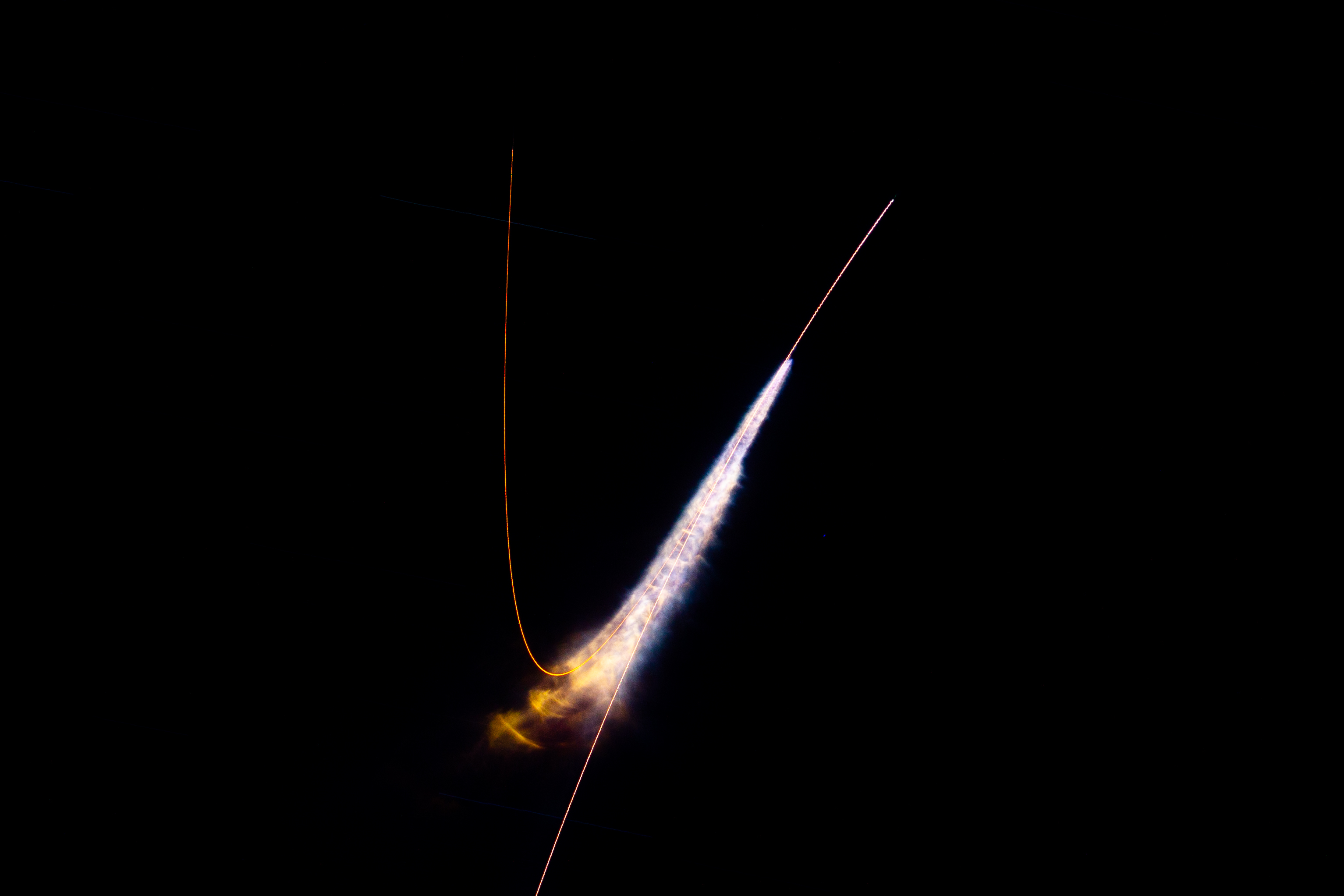
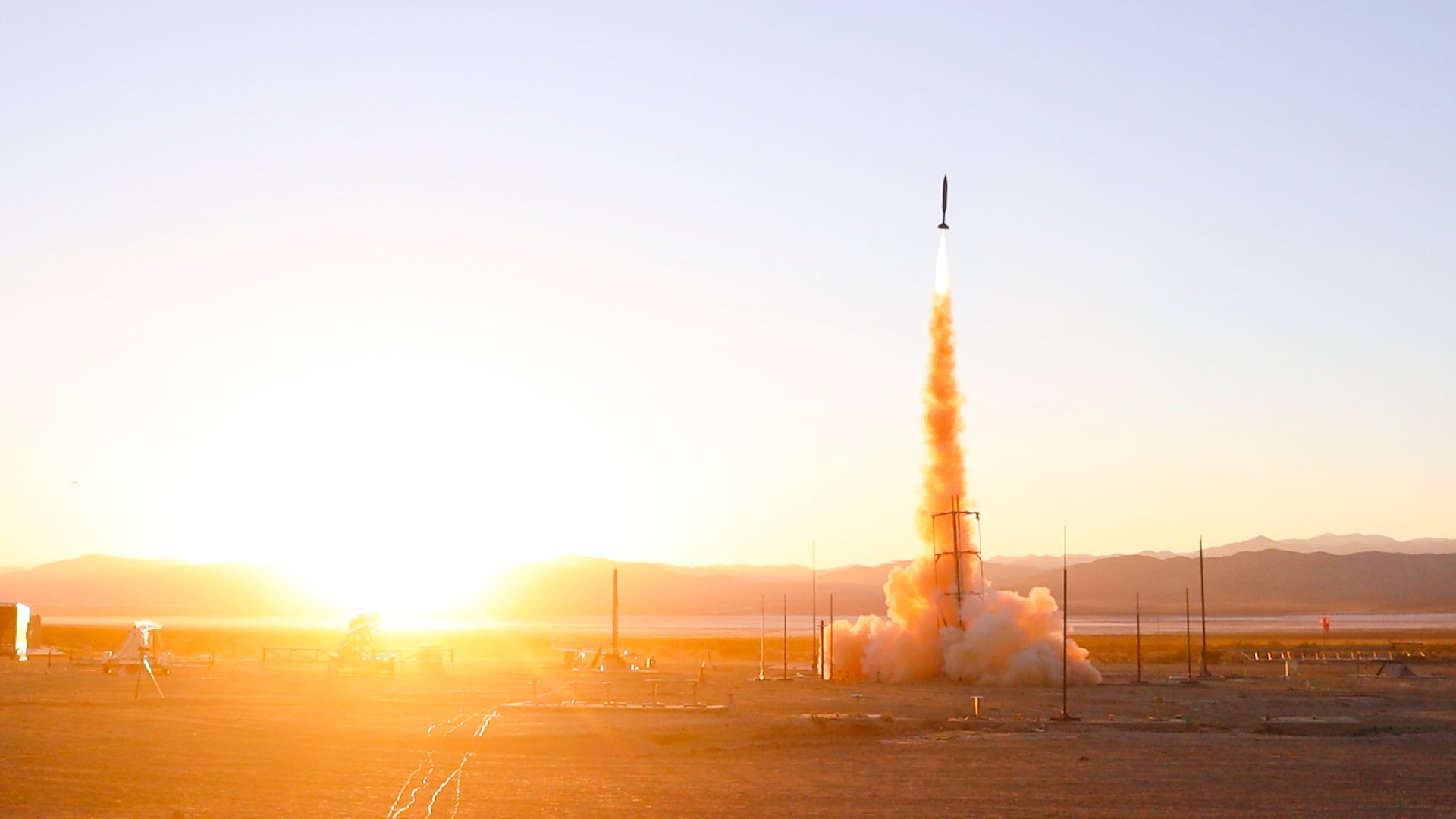 Launch of Mach Pumpkin on November 1st, 2025 at the Friends of Amateur Rocketry test range.